
You had a good first call. The lead was interested, asked sensible questions and said they would think about it. Then nothing.
This happens to almost every freelancer and small agency. In most cases the lead did not say no. The deal just lost momentum, because nobody decided anything.
This article explains why it happens and gives you a five-step follow-up plan for the next 14 days. If your leads go quiet even earlier, start with why good freelance leads go cold.
Why leads go quiet after the call
Four causes show up again and again:
- No clear next step. The call ended with “I will send you something.” Who sends what, and by when, was never agreed.
- The proposal arrives too late. Every day without a written next step gives the lead more time to move on to something else.
- The lead cannot explain your offer to someone else. They liked you, but they have to convince a partner or a boss, and they have nothing to forward.
- Your follow-up gives them nothing to answer. “Just checking in” is easy to ignore.
None of these is about price. They are process problems, and a process can be fixed.
The 14-day follow-up plan
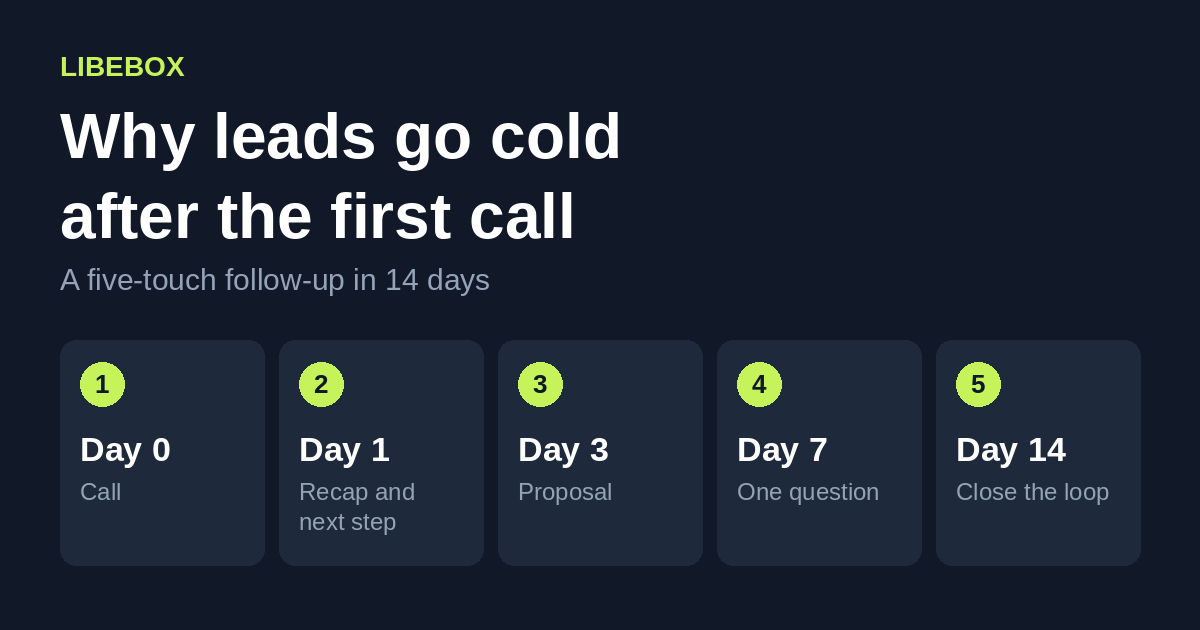
Five touches, each with one job. Keep every message short.
Day 0: End the call with a next step
Before you hang up, agree on three things: what you will send, when they will get it, and when you will talk again. Put dates on it. “I will send the proposal by Thursday, and we can go through it on Monday at 10” is a next step. “Talk soon” is not.
Day 1: Send a short recap
Within 24 hours, email a recap with the problem they described, what success looks like, and the next step you agreed. Four or five lines is enough. It shows you listened, and it gives them something to forward to their team.
Day 3: Send the proposal
Keep it to one page if you can: the outcome, the scope, the price, the timeline and what you need from them. For help with the structure, see how to write a quote around outcome, scope and price. Ask for a decision by a specific date, not “whenever you are ready”.
Day 7: Ask one easy question
If you have heard nothing, do not write “just checking in.” Ask one question that is easy to answer, for example: “Is the timeline the main concern, or the budget?” A specific question gets a specific answer. Even “it is the budget” helps, because now you can talk about scope.
Day 14: Close the loop
Send a polite last message: “I will close this on my side for now. If the timing changes, just reply here and I will pick it up.” No pressure and no guilt. Some leads answer this one because it takes the pressure off them. Then move the lead to a “later” list and set a reminder for 60 days.
Two messages you can copy
Day 1 recap
Hi [Name], thanks for the call today. Quick recap:
The problem: [one sentence]. What success looks like: [one sentence]. Next step: I will send the proposal by [day], and we will talk on [date].
If I missed anything, tell me and I will fix it.
Day 7 question
Hi [Name], I have not heard back, so I will make this easy. Is the main question the timeline, the budget, or something else?
Track every open lead in one place
A follow-up plan only works if you can see who is waiting for what. Keep one list of open leads with the date of your last message and the next step for each. A spreadsheet is enough. Look at it once a week for ten minutes. If you need a starting point, our client pipeline guide shows a simple setup, and this guide to lead qualification helps you avoid chasing leads that were never a fit.
What to do next
Pick the last three leads that went quiet and send each of them the Day 7 question today. You will learn more from those answers than from another week of waiting.
Not sure whether follow-up is your weakest area? Take the free Libebox business audit and find out where to start.