If AI touches your client work, tell your clients. Do it once, clearly, and before they ask. A short written disclosure costs you nothing, prevents awkward conversations later, and makes your process look more professional, not less. Below you’ll find when disclosure matters, what clients actually want to know, and copy-ready templates you can adapt today.
Most people still don’t say anything
AI is already part of everyday client work: research, first drafts, summaries, code, images, translations. Yet very few service providers say so. A CHI 2026 study of 100 freelancers and 145 clients, summarized by 9am.works, found that only 8.6% of freelancers tell clients they use AI. About a quarter of clients (25.9%) expect to be told without having to ask. Most clients said they encourage AI use in some form. (It’s a small study, so treat the numbers as a signal, not a market fact.)
That gap is the real risk. Clients rarely object to AI itself. They object to finding out later.
Do you have to disclose AI use?
It depends on three things: the law, your contracts, and your client relationship.
- The law. In the EU, the transparency rules of the AI Act (Article 50) have applied since August 2026. Chatbots must tell people they are talking to an AI, and anyone who publishes deepfakes must label them. The duty to mark AI output in machine-readable form sits with the providers of AI tools, and tools that were already on the market have until 2 December 2026. None of this creates a general duty to tell clients you used AI to draft a document. Rules differ by country and industry, so check what applies to you.
- Your contracts. This is where most real obligations sit. Many clients now add AI clauses to their agreements: disclosure duties, bans on uploading their data to AI tools, or warranties about originality. Read your existing contracts before you write anything new.
- Your relationship. Even when nothing forces you to disclose, clients who discover AI use on their own tend to ask uncomfortable questions. Was my data safe? Did anyone check this? Why am I paying the same price?
In practice, proactive disclosure is the safer default for any agency or freelancer selling expertise.
The two-level rule: working aid vs. deliverable
Not every use of AI needs the same treatment. A practical way to decide is to separate two levels:
| How AI was used | Example | What to do |
|---|---|---|
| As a working aid. You reworked and checked the result. | Research, outlines, first drafts, code completion, summarizing a call | Cover it in a general disclosure (website, proposal, contract). Answer honestly if asked. |
| Inside the deliverable. The client receives AI output largely as generated. | Generated images, synthetic voice, AI-written passages, AI-produced video | Tell the client before delivery, ideally in the proposal, and get their OK. |
Two things are never optional, whatever the level: protecting client data (no confidential material in tools that train on inputs) and human review before anything reaches the client.
What clients actually want to know
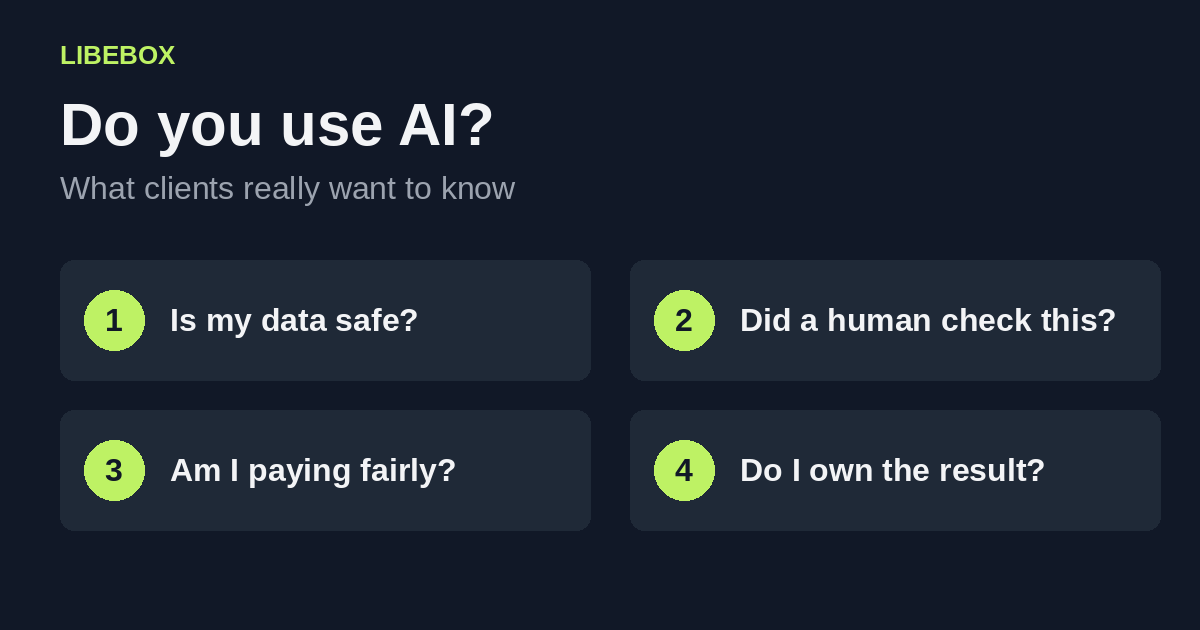
When a client asks “Do you use AI?”, they usually mean one of four things:
- Is my data safe? Which tools see my files, and do they train on them?
- Did a human check this? Who is accountable for accuracy?
- Am I paying fairly? If AI saves you time, what am I paying for?
- Do I own the result? Can I use the deliverable without legal surprises?
A good disclosure answers all four in plain language, before the question comes up.
Copy-ready disclosure templates
Adapt these to your business. Replace the bracketed parts and remove anything that isn’t true for you.
Template 1: Short statement for your website or proposal
We use AI tools to speed up research, drafting, and routine production. Every deliverable is reviewed, edited, and approved by [our team / me] before it reaches you. We never upload your confidential material to AI tools that use it for training, and we’ll always ask before using AI-generated images, audio, or video in your project.
Template 2: Proposal or contract section (summary language)
Use of AI tools. [Agency] may use AI tools as a working aid for research, drafting, and analysis. All work is reviewed by a qualified team member before delivery. AI-generated content that forms part of the final deliverable (such as images, audio, video, or substantial text) will be disclosed in advance and used only with the client’s approval. Client data marked confidential will not be entered into AI tools that retain or train on inputs. A current list of tools used is available on request.
This is a starting point, not legal wording. Have a lawyer review contract language for your country.
Template 3: Line for a specific project or delivery
For this project we used [tool] to [create the first draft of X / generate background images for Y]. [Name] reviewed and edited the result. No confidential client data was entered into the tool.
Template 4: Answer when a client asks directly
Yes, we use AI as a working aid, mainly for [research and first drafts]. It makes us faster, but it doesn’t replace judgment: everything you receive is checked and edited by [me / our team], and your confidential files never go into tools that learn from them. If you’d prefer we avoid AI on your account, tell us and we’ll note it.
Template 4 works because it is direct, specific, and gives the client a choice. Avoid vague answers like “we’re experimenting with AI.” They sound evasive.
Five mistakes to avoid
- Disclosing after the client finds out. The same sentence reads as transparency before and as an excuse after.
- Overclaiming. Don’t say “100% human-made” if a tool helped. Don’t say “AI-powered” if it barely did.
- Hiding the review step. Clients care less about the tool than about who checked the output. Name the human.
- Ignoring subcontractors. If freelancers work on your projects, they need the same AI rules. Your disclosure covers their work too.
- Writing it once and forgetting it. Tools change every few months. A disclosure that lists last year’s tools is worse than none.
Keep your disclosure current
A disclosure is only as good as its last update. Every time you add a tool, change a workflow, or win a client with stricter rules, the document needs to change with it. That’s easy to promise and easy to forget.
The AI Client Trust Passport is a living document for freelancers and small agencies. It records which AI tools touch client work, what data stays protected, where human review is mandatory, and what needs client approval. It’s built to be updated as your tools and clients change. $19/month.
Want a free starting point first? Grab the AI policy template. And if you’re not sure which part of your business needs attention first, run the free Business Audit. It includes an AI Client Trust score. For the data side of the story, see our guide to a freelancer AI policy for client data.
Quick checklist
- A short AI statement on your website or in proposals
- An AI section in your contract template (reviewed by a lawyer)
- Rules for confidential client data in AI tools
- A named review step before delivery
- Advance notice for AI-generated content in deliverables
- The same rules for subcontractors
- A review date for your disclosure
This article is general information, not legal advice. Requirements depend on your country, industry, and contracts. AI Act dates checked October 2026; check current rules before relying on them.
Sources:
- 9am.works: Should you tell clients you use AI?
- DPO Consulting: What the Digital Omnibus changes for companies
Last updated: October 2026.