
Chasing a late payment feels awkward because it mixes two questions: a business one (where is my money?) and a personal one (will this hurt the relationship?). The fix is not a firmer tone. It is a system you decide on in advance, so you are not choosing words while annoyed.
This article gives you a simple follow-up schedule, three short message templates and a rule for when to pause work. It is general information, not legal, tax or financial advice.
Set the rules before the invoice exists
Most payment problems start in the quote. Put your payment terms in writing: when you invoice, how many days the client has to pay, and what happens if payment is late. If you build quotes around outcome, scope and price, add the payment dates there too. Our guide on how to quote around outcome, scope and price shows the structure.
- Invoice on a fixed trigger, such as delivery or a milestone.
- State the payment term on the invoice, both in days and as a date.
- For larger projects, ask for part of the fee upfront.
- Know who approves payment at the client, not just the company name.
The follow-up schedule
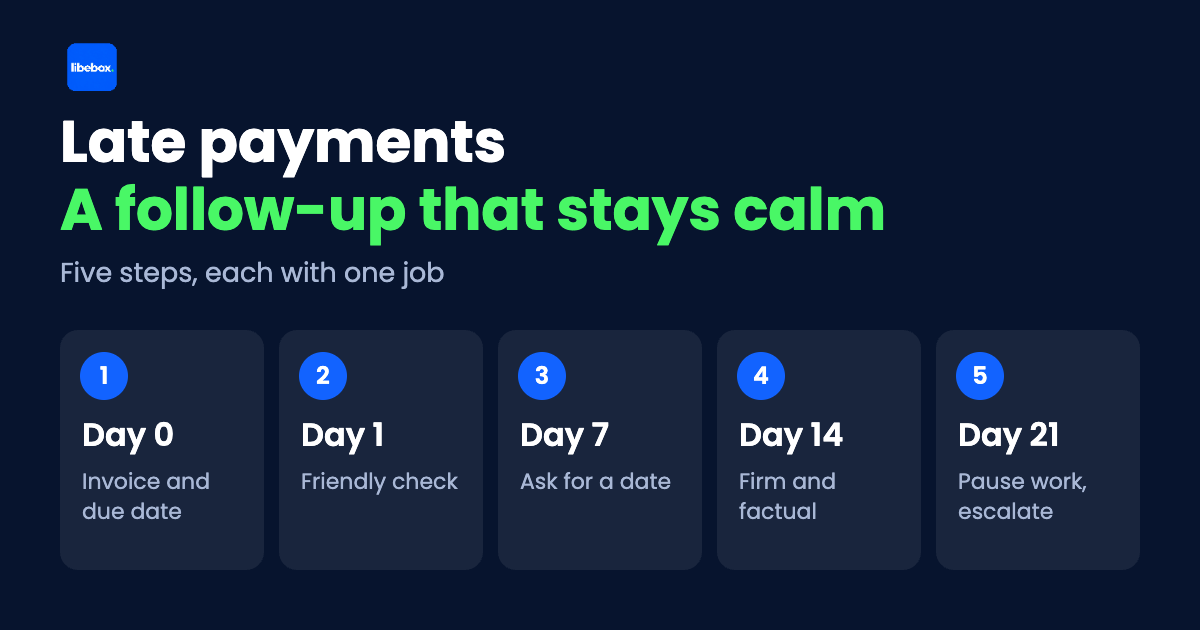
Five steps, each with one job. Adjust the days to your payment terms.
Day 0: Send the invoice with a short note
Email the invoice, repeat the due date in the message and ask the client to confirm they received it. That small question catches wrong addresses and missing purchase order numbers early.
Three days before the due date: An optional heads-up
A one-line reminder works well for large invoices or clients with approval processes. Skip it for clients who always pay on time.
Day 1 after the due date: A friendly check
Hi [Name], a quick note that invoice [number] for €[amount] was due yesterday. Could you let me know when I can expect payment? I have attached the invoice again for convenience.
Day 7: Ask for a date
A vague promise is hard to follow up. A specific date is not.
Hi [Name], I have not received payment for invoice [number], which was due on [date]. Could you confirm by [date] when it will be paid? If something is blocking it, tell me and I will help sort it out.
Day 14: Be firm and factual
Hi [Name], invoice [number] is now 14 days overdue. Please pay by [date]. If I have not received payment by then, I will pause work on [project] and, where it applies, charge late-payment interest and fees.
Keep the tone calm. State the facts, the date and the next step. Do not apologise, argue or explain how much you need the money.
Day 21 and later: Pause work and escalate
Pausing work is the clearest signal, and it needs to be in your terms before you use it. After that, consider a formal payment demand, a collection service or legal advice, depending on the amount and your country.
Late-payment interest and fees
Many countries have rules for late payments between businesses. In Germany, for example, a business customer in default owes interest of nine percentage points above the base rate, plus a flat fee of €40, under section 288 of the German Civil Code (BGB). Other countries work differently, consumers are treated differently, and the details depend on your contract and on when the customer is considered in default. Check the rules for your country or ask a professional before you rely on them.
Keep it all in one place
Follow-ups fail when nobody remembers who is waiting. Keep one list of open invoices with the due date, the amount, the last message you sent and the next step. A spreadsheet is enough, and you can set it up the same way as in our client pipeline guide. Look at it once a week.
If you use automation, let it draft the reminder email or remind you of the date. Keep a person in the loop for the firm messages, because those are the ones that protect the relationship.
What to do next
Write the three templates once and save them as drafts. Then add payment terms to your next quote, so you do not have to write a difficult email from scratch.
Not sure whether getting paid on time is your weakest area? Take the free Libebox audit. It takes a few minutes and shows where you may be losing the most time and money.
This article is general information, not legal, tax or financial advice. Rules on late payments differ by country and by contract.