
Manual admin rarely feels expensive. It feels like ten minutes here and twenty minutes there: renaming files, copying details between tools, chasing a status update, retyping the same email.
In a three-person agency those minutes add up to a real cost, and you can put a number on it. This article shows you how, with a worked example you can adapt, and how to decide what to automate first.
A simple way to price your admin time
You need three numbers: the hours per week each person spends on repeatable admin, what an hour of their time is worth, and the number of working weeks in a year. Multiply them.
Repeatable admin is work you do the same way every time: onboarding steps, status updates, copying lead details into a tracker, invoice reminders, filing documents and writing meeting recaps.
A worked example
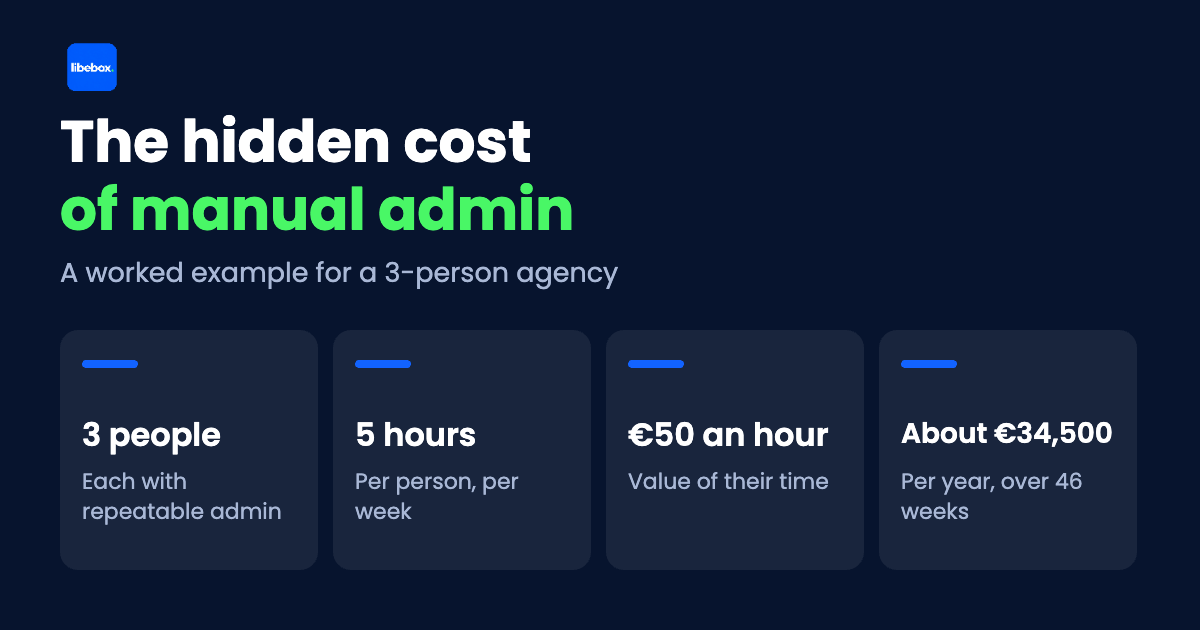
- 3 people
- 5 hours a week each on repeatable admin, so 15 hours a week in total
- €50 an hour as the value of their time
- 46 working weeks a year
15 hours × 46 weeks is 690 hours a year. At €50 an hour, that is about €34,500.
This is an example, not a benchmark. Your numbers will differ, and the right hourly value depends on whether the time would otherwise be billed or spent on sales and delivery. The method is what matters, so use your own figures.
Why the real cost is higher
The formula only counts the hours. Manual admin has other costs that are harder to see:
- Interruptions. A five-minute task in the middle of focused work often costs more than five minutes.
- Mistakes. Copying data by hand leads to wrong details, missed handovers and late invoices.
- Delays. Work waits until someone remembers the next step, and clients notice.
- Single points of failure. If a process lives in one person’s head, it stops when that person is away.
What is worth automating first
You do not need to automate everything. Automating an unclear process only makes the confusion faster. Use three tests:
- You do it at least once a week.
- You do it the same way every time.
- A mistake would annoy a client or cost money.
Work that passes all three tests is the best place to start. In most small agencies that means client onboarding, lead capture, invoice and payment reminders, and weekly status updates. If onboarding is on your list, our client onboarding checklist is a good first step before you automate anything.
How much can you actually remove?
Not all of it. Judgement calls, client conversations and creative work stay with people. In the example above, if one third of those hours turn out to be automatable, the saving is about 230 hours, or roughly €11,500 a year. Even half of that is worth a weekend of setup.
Treat that as a hypothesis. Automation does not guarantee savings: setup takes time, tools change and some tasks turn out to need a human. Check the result after a month with a simple time log, not a guess.
A four-week plan to start
Week 1: Track
Write down every repeatable admin task for five working days, with a rough time next to each. A note per task is enough.
Week 2: Pick one
Choose the task with the most hours that passes the three tests above.
Week 3: Write it down
List the steps and the exceptions. If you cannot describe the task in a short list, it is not ready to automate yet.
Week 4: Automate one step and measure
Use a tool you already pay for, or a visual tool. Compare your hours after two weeks. If you want a first tool, read how to start with one n8n workflow, Make for freelancers or n8n vs Make.
Admin is not the only hidden cost in a small agency. Extra work that nobody priced is another one, and we put numbers on it in how much scope creep really costs.
What to do next
This week, log your repeatable admin for five days and run the formula with your own numbers. The total is often a surprise, and it tells you whether automation is worth your time.
Not sure whether admin is your weakest area? Take the free Libebox audit. It takes a few minutes, and it shows where you may be losing the most time and money.