
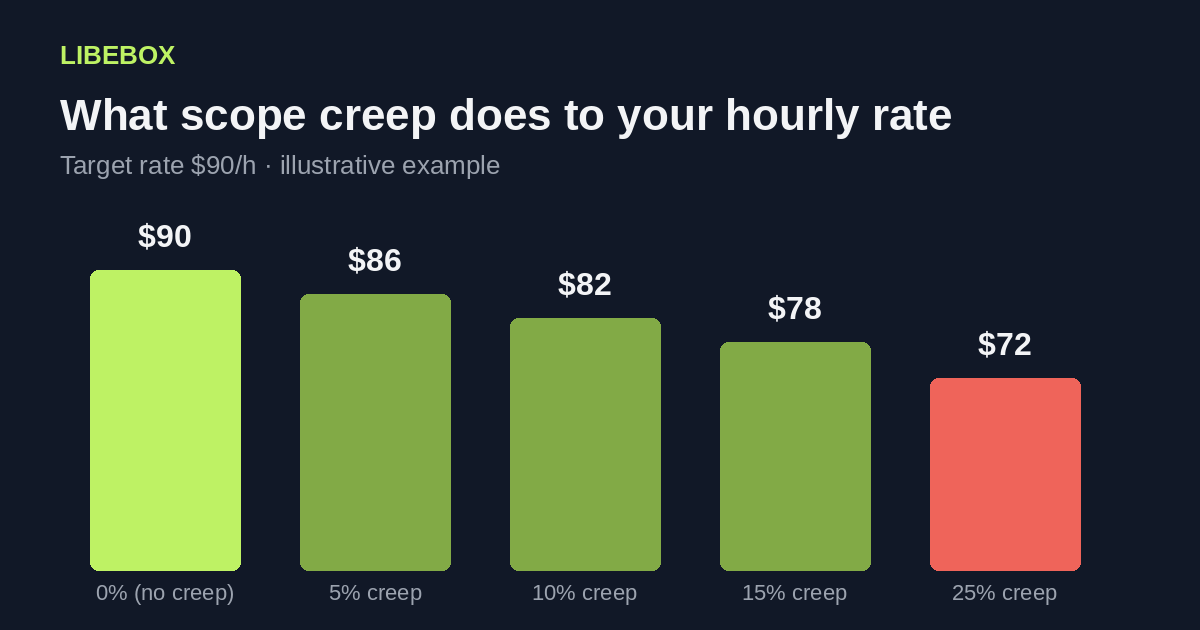
Scope creep almost never feels expensive in the moment. It’s a quick call. One more revision round. “Could you also just add…” followed by something that takes forty minutes.
Then the project ends, and you realize you worked far more hours than you billed. And you can’t point to a single moment where it went wrong.
That’s what makes it hard to fix. So let’s put a number on it.
The simple formula
You need four numbers from a recent project:
- Hours you quoted (what the price was based on)
- Hours you actually worked
- What you charged
- Your target hourly rate
Then:
Unbilled hours = actual hours − quoted hours
Cost of scope creep = unbilled hours × your target rate
Effective hourly rate = what you charged ÷ actual hours
The third number is the one that hurts. It shows what you really earned per hour on that job.
A worked example
Take a small agency with a blended target rate of $90 an hour. A typical project is quoted at 120 hours and priced at $10,800.
Now imagine the project quietly grows by 15%. That’s 18 extra hours of small requests, extra revisions, and “quick” calls. Nobody invoiced them.
- Actual hours: 138
- Effective hourly rate: $10,800 ÷ 138 = $78, not $90
- Unbilled value on that one project: 18 × $90 = $1,620
One project, no drama, and you’ve given away $1,620 of work. Now multiply it by the number of projects you run in a year. (The numbers below are an illustration, not a benchmark. Plug in your own.)
| Creep on quoted hours | Extra hours per project | Per year (10 projects) | Value at $90/h | Effective rate |
|---|---|---|---|---|
| 5% | 6 | 60 h | $5,400 | $86 |
| 10% | 12 | 120 h | $10,800 | $82 |
| 15% | 18 | 180 h | $16,200 | $78 |
| 25% | 30 | 300 h | $27,000 | $72 |
At 15% creep across ten projects, you’ve given away 180 hours. That’s more than a month of full-time work for one person.
Why the real cost is higher than the number
The table only counts the hours. The real damage is usually bigger, for three reasons.
It eats capacity you could have sold. If those 180 hours had gone to paid work, you’d have earned that revenue. Unbilled hours also block new projects.
It delays everything else. Overrun on project A pushes project B. Now you’re apologizing for late delivery on work that was scoped correctly.
It trains your clients. If the first extra request is free, the second one is expected. Clients don’t take advantage on purpose. They simply learn what “normal” looks like from you.
Where scope creep actually comes from
In small agencies, it’s rarely one bad client. It’s usually one of these:
- A vague scope. “Website redesign” with no list of pages, no revision limit, no definition of done.
- Revision rounds with no cap. Feedback comes in drips instead of in one consolidated round.
- Requests made on calls. Someone asks, you say yes, and it never becomes a written change, so it never gets priced.
- Fear of the awkward conversation. You know it’s out of scope. Saying so feels worse than absorbing it.
The last one is the most common, and it’s the one that processes can fix.
Four fixes you can use this week
1. Write what’s out of scope, not just what’s in. Add a short “not included” list to every proposal. It takes ten minutes and prevents most arguments.
2. Cap revisions and define them. Two consolidated rounds is a common starting point. Anything after that is billed at your hourly rate. Put it in writing before the project starts, ideally as part of your client onboarding checklist.
3. Use a one-paragraph change request. When a client asks for something new, reply with the same template: what they asked for, how many hours it adds, what it costs, and the new delivery date. Keep it friendly and factual (here is a full change request process you can adapt). The template removes the awkwardness.
4. Track actual hours against quoted hours, per project. You can’t manage what you only feel. A simple sheet with two columns (quoted, actual) is enough. Review it at the end of each project.
None of this makes you rigid. Clients generally respect a clear process more than a vague “sure, no problem” that later turns into resentment.
A quick self-check
Look at your last three projects. For each, compare quoted hours with actual hours.
If the gap is under 5%, your scoping is solid. If it’s 10% or more on most projects, scope creep is a pricing problem, not a client problem. The fix is in the process, not in working harder.
Find out where your business leaks
Scope creep is one of five areas where small agencies and freelancers lose money without noticing. If you’d like to see where your business is weakest, take the free Business Audit. It takes a few minutes, scores five operating areas, and points to the one that’s holding you back most.
Last updated: October 2026. The figures in this article are illustrative examples, not industry benchmarks.